Gilbert Keith Chesterton
vote now
add a comment
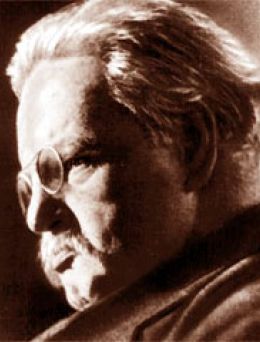
Biography Gilbert Keith Chesterton (1874-1936)
English writer, essayist, poet, novelist, journalist, literary critic and Christian thinker.
Was born on 29 may 1874.
Died on 14 jun 1936, at 62 years old.
Died on 14 jun 1936, at 62 years old.
Origin country United Kingdom
Title:
Biography of Gilbert Keith Chesterton
Gilbert Keith Chesterton, often known as G. K. Chesterton, was one of the most vivid and original personalities of English literature in the early twentieth century. A writer, essayist, poet, novelist, journalist and literary critic, Chesterton remained in European cultural memory through his brilliant intelligence, his unmistakable humor and the paradoxical way in which he managed to express profound truths.
He was born in London, into a cultivated family, in an environment where reading, imagination and curiosity were encouraged. In his youth he studied art, and this closeness to drawing and imagery can later be felt in his writing. Chesterton’s sentences often have visual force, color and contrast, as if ideas were transformed into living scenes.
Chesterton was not an author easy to classify. He wrote about literature, religion, politics, morality, family, freedom and society, but he always did so with a special energy. He had the talent of looking at ordinary things as if he had discovered them for the first time. For him, the world was not banal, but full of mystery, beauty and meaning.
His literary style is recognized for the use of paradox. Chesterton took apparently simple ideas and turned them on every side, discovering unexpected depths within them. His writing combines logic, imagination, irony and faith in a rarely encountered way. That is why his texts can be read both for the pleasure of the language and for the depth of the ideas.
He wrote enormously, leaving behind a vast body of work that includes essays, novels, poems, newspaper articles, literary biographies, religious texts and detective stories. Among his best-known works are The Man Who Was Thursday, Orthodoxy, The Everlasting Man and the series of stories featuring Father Brown.
The character Father Brown is one of Chesterton’s best-known creations. This priest-detective does not impress through strength or spectacular methods, but through his understanding of the human soul. He solves mysteries because he understands people’s weaknesses, fears and contradictions. Through Father Brown, Chesterton brought a distinct moral and spiritual dimension to detective fiction.
As an essayist, Chesterton was a master of memorable formulations. He wrote with humor, courage and elegance, even when approaching serious themes. He was not afraid of controversy, but his controversy had charm. He liked to challenge the dominant ideas of his age and to show that tradition, faith and common sense can sometimes be more revolutionary than the intellectual fashion of the moment.
An important moment in his life was his conversion to Catholicism in 1922. Faith became an essential part of his mature thought, but Chesterton did not treat religion as a simple cold doctrine. For him, faith was a way of looking at the world with wonder, gratitude and lucidity.
Chesterton was also a careful critic of modernity. He looked with distrust at materialism, the standardization of society and the ideologies that reduced the human being to economics, statistics or a social mechanism. Instead, he defended the ordinary person, the family, the local community, inner freedom and the dignity of simple life.
His contemporaries described him as an impressive presence: jovial, generous, massive, full of verve and always ready for a brilliant conversation. He was a friend, intellectual rival and dialogue partner for numerous important figures of his time. His personality was as memorable as his writing.
The legacy of Gilbert Keith Chesterton remains strong even today. He is read as a novelist, essayist, author of detective fiction, Christian thinker and critic of the modern world. His charm comes from his ability to unite laughter with reflection, simplicity with depth and imagination with moral truth.
Chesterton remains an author who offers not only texts, but also an invitation to rediscover the world. In his writings, ordinary things become surprising, and old questions gain a new freshness. Precisely for this reason, his work continues to attract readers interested in literature, spirituality, intelligent humor and ideas that stand the test of time.
Important milestones
- Full name: Gilbert Keith Chesterton
- Known as: G. K. Chesterton
- Nationality: English
- Fields: literature, essays, poetry, journalism, literary criticism, Christian apologetics
- Famous character created: Father Brown
- Literary style: paradoxical, ironic, spiritual, moral and full of imagination
- Frequent themes: faith, freedom, tradition, mystery, the ordinary person and criticism of modernity
Why is Gilbert Keith Chesterton important?
Gilbert Keith Chesterton is important because he managed to be, at the same time, a popular writer and a profound thinker. He wrote accessible, vivid and humorous texts, but behind them lie great questions about truth, faith, morality, freedom and the meaning of existence.
Through his novels, essays and stories, Chesterton demonstrated that literature can be intelligent without being cold, spiritual without being rigid and moral without becoming boring. This combination makes him, even today, a living, surprising and relevant author.
Comments
Rate this author:
De la Ernest Herbert Mills - one or more third parties have made copyright claims against Wikimedia Commons in relation to the work from which this is sourced or a purely mechanical reproduction thereof. This may be due to recognition of the "sweat of the brow" doctrine, allowing works to be eligible for protection through skill and labour, and not purely by originality as is the case in the United States (where this website is hosted). These claims may or may not be valid in all jurisdictions.As such, use of this image in the jurisdiction of the claimant or other countries may be regarded as copyright infringement. Please see Commons:When to use the PD-Art tag for more information., Domeniu public, https://commons.wikimedia.org/w/index.php?curid=25439333


