Simonides of Ceos
vote now
add a comment
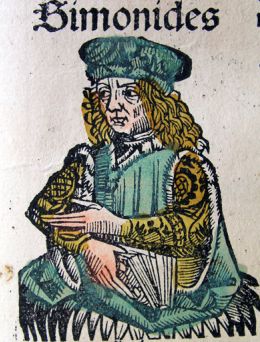
Biography Simonides of Ceos (556 i.Hr - 468 i.Hr)
Greek lyric poet
Also called: Simonides.
Life period: 556 i.Hr - 468 i.Hr
Origin country Greece
Simonides of Ceos (also known as Simonides of Ceos) was one of the most important poets of ancient Greece, renowned for the elegance of his verse, the emotional force of his poems, and his decisive role in the development of lyric poetry. He is considered a major figure in archaic and classical Greek literature, being appreciated both in his own time and by subsequent generations.
Origins and beginnings
Simonides was born on the island of Keos, a small region with important cultural traditions. Although he did not come from an era in which biographies were documented in detail, tradition says that he was educated in the spirit of the arts and music, Greek lyric poets often also being interpreters of their own creations. In his youth, Simonides came into contact with the cultural centers of Greece, where poetry was an essential part of public life.
Poet of the courts and the cities
A significant part of his life was related to his work as a professional poet. In the ancient Greek world, poets were often invited by rulers and city-states to compose verses dedicated to victories, religious ceremonies or the commemoration of personalities.
Simonides was appreciated not only for his talent, but also for the way he could capture in a few verses ideas such as honor, memory, sacrifice and the fragility of life. He lived in periods when Greece was going through major political and military transformations, and his poetry became a kind of "voice" of collective commemoration.
Known for epigrams and the memory of heroes
One of Simonides' strongest legacies is related to his funerary epigrams, short verses written in honor of the dead, often intended for inscriptions on monuments. Even though not all the texts attributed to him have survived to our time in a secure form, tradition links him to some of the most famous ancient epitaphs.
Simonides is frequently associated with the famous commemorative expression dedicated to heroes fallen in battle, verses that became symbols of the idea of duty and devotion to the city. His style was sober, concentrated and profound, managing to convey emotion without exaggeration.
Lyrical poetry and victory odes
In addition to epigrams, Simonides composed victory odes dedicated to the winning athletes of the Panhellenic games, as well as lyric poems for religious ceremonies. In these creations, the balance between praise and moral reflection is remarkable: glory was not presented only as success, but as something ephemeral, linked to fate and the passage of time.
Through this approach, Simonides profoundly influenced later poets, being considered a precursor of the more "human" and more introspective style of classical lyric poetry.
The Legend of Memory and the “Art of Remembering”
A fascinating detail associated with the name of Simonides is that, in ancient tradition, he is considered one of the fathers of the art of memory (mnemonics). A famous legend says that he noticed the connection between memory and space, developing the idea that things can be remembered more easily if they are mentally associated with places and images.
Even though this story has mythical elements, it contributed to Simonides’ reputation as a poet of orderly mind, clarity, and mastery of language.
Importance and legacy
Simonides of Keos is considered a defining poet for Greek culture because he transformed poetry into an instrument of collective memory. His verses connected people to the idea of honor, respect for the dead, and the power of words to keep memory alive.
Although only fragments of his work have survived in its entirety, Simonides' name remains a landmark of classical poetry, and his influence is felt in the way Western literature understood the role of art: not only to delight, but also to preserve what time would erase.
Comments
Rate this author:


